I want to begin by saying that this research project was never “just” a two-hour focus group.
What you see in the summary sheets is the end result. What you don’t always see is the miles travelled, the conversations had on train platforms, the street walks in the dark, the workshops, the school visits, the listening, the observing – and most importantly, the voices of girls woven through every stage of this work.
This project set out to answer a simple but powerful question:
What would young women want from a Youth Zone in Crewe to make it somewhere they genuinely want to spend time?
Nationally, we know there is a gender gap. Some Youth Zones report attendance ratios of 70% boys to 30% girls. We know participation drops sharply when girls move from primary to secondary school. And we know from wider research that girls face real barriers — fear of judgement, lack of confidence, safety concerns, academic pressure, and feeling watched when exercising.
But statistics only tell part of the story.
So we travelled.
We visited Youth Zones in Warrington, Wigan, Manchester, Carlisle and London. We walked through the spaces when they were empty, and we observed them when they were full of life. We spoke to girls who attend regularly. We spoke to girls who don’t attend at all. We carried out focus groups in schools — including in one of the most deprived primary schools in Cheshire. We met with young people with learning disabilities. We met with young people experiencing school anxiety. We walked the routes from the bus station and train station to the proposed site. We asked parents what would make them feel comfortable.
And what I learnt through all of this is something both simple and profound.
Girls know exactly what they want.
They just rarely get asked.
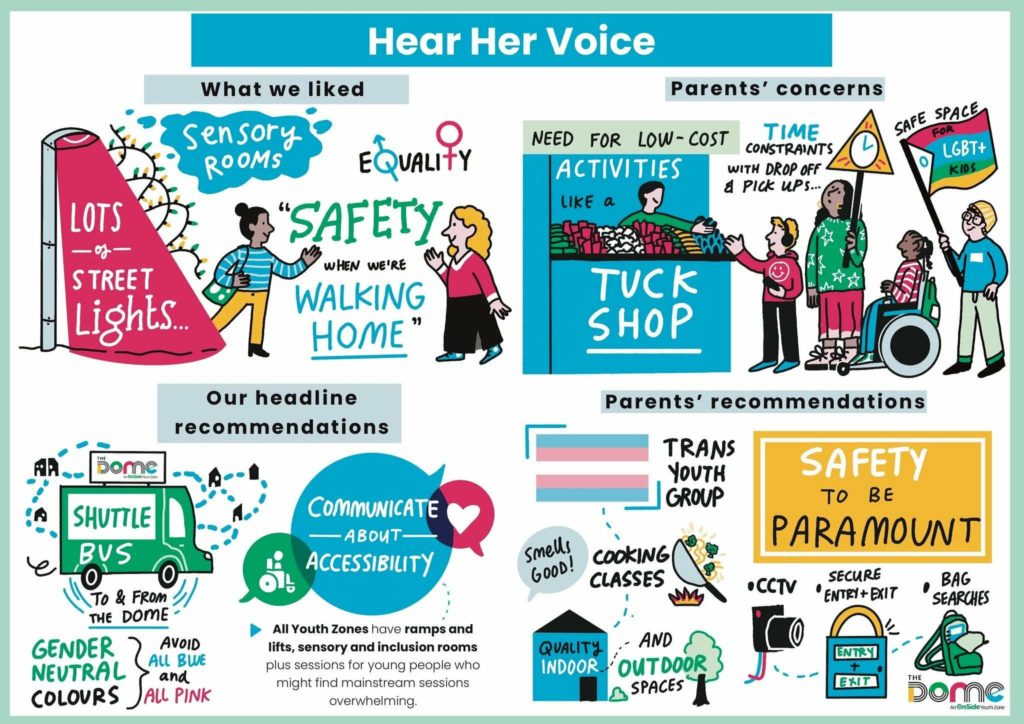
They want safe and welcoming environments.
They want private girls-only spaces alongside mixed spaces.
They want good female role models.
They want sport — but in ways that feel comfortable.
They want better changing facilities.
They want healthier food options.
They want somewhere to relax, somewhere to study, somewhere to just be.
And more than anything — they want to feel heard and valued.
One of the most interesting findings wasn’t always about specific activities. It was about “feelings.” Girls would say, “I don’t like that space,” or “that feels uncomfortable,” and sometimes they struggled to articulate why.
But as a woman myself — and as someone who runs a women and girls charity here in Crewe — I understand what they mean.
It’s the feeling of being on show when a climbing wall is behind glass.
It’s the discomfort of eating in an exposed café area.
It’s the anxiety of being watched in a gym.
It’s the subtle awareness of who else is in the room.
These aren’t dramatic objections. They’re quiet signals. But if we ignore them, girls simply won’t come.
We also explored safe spaces beyond the building itself. We carried out street walks. We examined lighting. We talked about transport. Over half of parents told us time or safety would prevent attendance if transport wasn’t available. Nearly all parents — 92% — said mental health and emotional support built into the service was essential.
This aligns with what we see every day in our charity work in Crewe. Girls’ mental health needs are significant. Anxiety is high. Confidence is fragile. And yet their potential is extraordinary.
As a charity, we are now actively exploring safe spaces specifically for girls. We are looking at PE provision and grassroots sport. We know from national research that 65% of teenage girls don’t like others watching them exercise. We know many avoid sport during their period. We know dream rates in sport are significantly lower than boys.
So when we talk about sport in the Youth Zone, this isn’t about assuming girls don’t want to participate. It’s about creating environments where they feel safe enough to try.
This research also highlighted the importance of co-production. The young women were not participants; they were co-researchers. They helped design the questions. They analysed findings. They presented to trustees. That model — trusting girls with responsibility and insight — is powerful in itself.
And finally, I want to say this.
It is genuinely encouraging that The Dome wants to invest in young women.
Because from our research, and from running a women and girls charity in Crewe, we know this investment is not just welcome — it is very much needed.
If we get this right, The Dome will not just be a building.
It will be a place where girls feel safe enough to take risks.
Confident enough to try sport.
Calm enough to relax.
Supported enough to talk.
And valued enough to return.
I also want to take a moment to talk about something that sits at the heart of this entire project — co-production.
Because this research was not done to young women. It was done with them.
A crucial element of this work has been the collaboration between Her Place and the youth co-researchers who helped design and carry out the evaluation. Researchers from the University of Chester have since examined this approach to explore the role and value of co-production within this project — and what it can teach others across the OnSide network.
So what do we mean by co-production?
Co-production is about building respectful and empowering relationships. It’s about sharing power. It’s about recognising that lived experience is expertise. It requires reflection, transparency, mutual respect, and a commitment to collective learning.
In simple terms — it means young women were not participants. They were partners.
For the trustees and stakeholders, it was imperative that we didn’t try to “solve” the gender imbalance without hearing directly from young women themselves. As one trustee said, it was important to hear the voice of young women and how they perceived the issues.
And for the young women who stepped forward as co-researchers, their motivation was deeply personal.
They wanted the opportunity to state their opinion.
They wanted to influence something their siblings might one day use.
They wanted to help create somewhere that other girls could go and feel safe.
One of them said, “I liked the fact that I would have a say in something that would affect my siblings in a good way.”
That is powerful.
As an organisation that exists to empower women and girls, it would have been contradictory not to place them at the centre of this work. And they weren’t just consulted — they were involved in designing questions, leading focus groups, visiting Youth Zones, walking routes, presenting to trustees, and analysing findings.
And what we found was remarkable.
The co-researchers reflected that when they went into schools and spoke to other young people, the conversations were different.
“It wasn’t adults coming to speak to them — it was us,” one said.
“They opened up to us more than they would to an adult.”
That peer-to-peer dynamic created depth. It created honesty. It created nuance. Girls gave more of their time. They explained their feelings. They trusted that they were being understood — not judged.
Because when we exclude young people from research about their own lives, we risk reinforcing adult-centric perspectives. We risk designing services based on what we think they need — rather than what they are actually experiencing.
And as one co-researcher put it, quite honestly:
“These decisions affect our future, not theirs.”
The young women spoke openly about safety because they had lived it. They spoke about feeling unsafe walking home. They spoke about judgement in school corridors. They spoke about adults sometimes thinking they know better — or comparing teenagers now to what it was like decades ago.
Co-production ensured that this wasn’t about nostalgia or assumptions. It was about relevance. It was about current lived experience.
And perhaps one of the most telling reflections came when they were asked whether they felt listened to.
They said yes.
But they also said — “I’ll believe it when I see it.”
That is the challenge to all of us.
Co-production does not end when the report is written. Its value is realised when ideas are implemented. When privacy screens are installed. When girls-only gym sessions are programmed. When transport is considered. When wellbeing rooms are prioritised.
And importantly, the young co-researchers expressed a hope that this wouldn’t be a one-off. They spoke about wanting youth councillors. Ongoing involvement. Continued voice. They want co-production to become part of the culture — not just part of this project.
That is the real opportunity here.
If we truly want The Dome to be a place where girls feel safe, confident and valued, then co-production must continue. It must become embedded. It must move from being a method to being a mindset.
Because when young women are trusted with responsibility, insight and influence — they rise to it.
And when they can one day walk into that building and say, “I helped shape this” — that is empowerment in its truest sense.
Girls know what they want.
Now we have the opportunity — and the responsibility — to listen.